Jump to heading Module 6-03 Quadrilateral

Jump to heading 1.Parallelogram

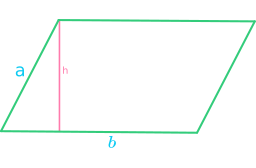
The lengths of the two sides of the parallelogram are a,b, the height with b as the base is h, the area is S=bh, and the perimeter is C=2(a+b).
Jump to heading 2.Rectangle

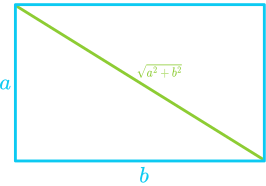
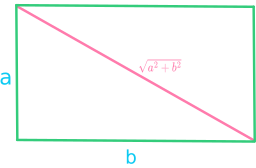
The lengths of the two sides of the rectangle are a,b, the area is S=ab, the perimeter is C=2(a+b), and the diagonal is l=a2+b2.
Jump to heading 3.Rhombus

The length of the four sides of rhombus is a, the height with a as the base is h, the area is S=ah=12l1l2, where l1,l2 are the lengths of the diagonals respective, and the perimeter is C=4a.
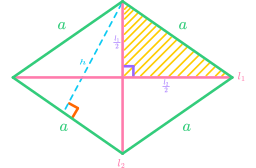
S=12×l12×l22×4=l1l22

Jump to heading 4.Square

The length of the four sides of a square is a, the four internal angles are 90, the area is S=a2, and the perimeter is C=4a.
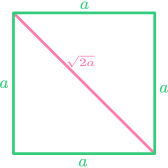
According to the Pythagorean theorem c=a2+b2, diagonal is 2.

Jump to heading 5.Trapezoid

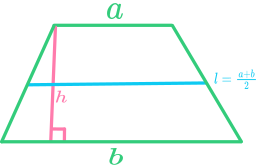
  • The upper base of the trapezoid is a, the lower base is b, the height is h, the median is l=12(a+b), and the area is S=12(a+b)h.

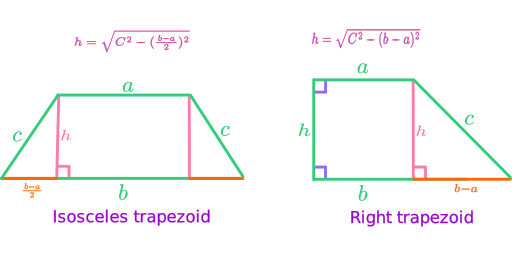
  • Note: There are two special types of trapezoids — the isosceles trapezoid and the right trapezoid.

Jump to heading 6.Butterfly Theorem

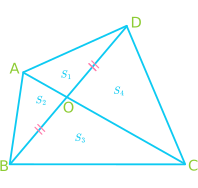
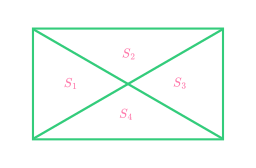
The butterfly theorem provides us with a way to solve the area problem of irregular quadrilaterals by constructing a model; on the one hand, the area relationship of the irregular quadrilateral can be linked to the triangles inside the quadrilateral, on the other hand, the proportional relationship of the diagonal corresponding to the area can also be obtained.

Jump to heading 1Proportional Relations in Any Quadrilateral (Figure 6–23)
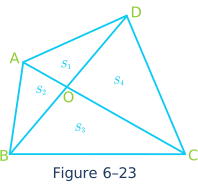
  1. S1S2=S4S3=ODOB
    According to the ratio of areas of triangles with equal heights being equal to the ratio of their bases, we have S1×S3=S2×S4 (Top×Bottom=Left×Right).

    S1S2=ODOB=S4S3Equal heightarea ratio=base ratio

  1. According to the basic proportionality theorem S1S2=S4S3=ODOB=S1+S4S2+S3.
    Similarly, S1+S2S4+S3=AOOC.

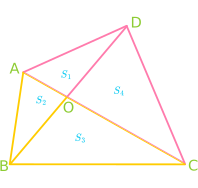
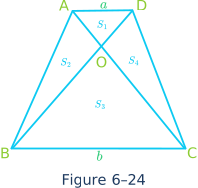
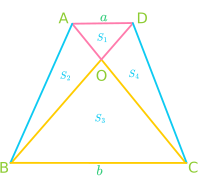
Jump to heading 2The Butterfly Theorem of Trapezoid and Similar Proportions (Figure 6–24)

  1. S1S2=S4S3=ODOBGeneral property of any quadrilateral=ab.

    ab=ODOB=OAOC
  1. S1×S3=S2×S4General property of any quadrilateral.
  1. S1S3=a2b2 (Similar).
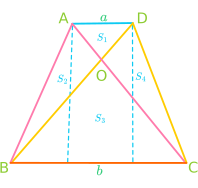
  1. S2+S3=S4+S3S2=S4.

    S=12ahEqual base and heightsame area
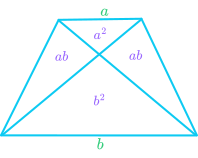
  • By combining the above four, the unified proportion is obtained: S1:S3:S2:S4=a2:b2:ab:ab.

    Jump to heading Formula derivations

    S1:S3:S2:S4=a2:b2:ab:ab

    S1S3=a2b2S1S2=abS1S2=ab×aa=a2abS1=a2S1:S3:S2:S4=a2:b2:ab:ab


Jump to heading 7.Focus 1

Square

  • The length of the four sides is a, the four interior angles are 90, the area is S=a2, and the perimeter is C=4a.

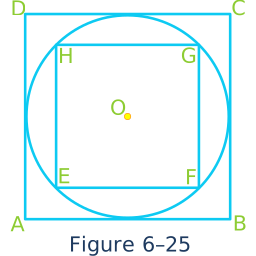
Jump to heading 28Figure 6–25, it is known that circle O is inscribed in square ABCD, and that square EFGH is inscribed in circle O. It is known that the area of square ABCD is 1, then the area of square EFGH is ?.

(A)23(B)12(C)22(D)23(E)14

Jump to heading Solution

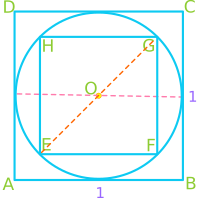
  • 1Show known conditions EG diagonal is the diameter of the circle

    EG=a2+a2=2a2=a2Pythagorean theoremAB=EG=1AB=2×EF=1EF=12=12×22=22SEFGH=(22)2=24=12

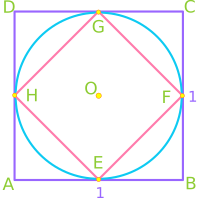
  • 2Connecting the midpoints of the sides of any quadrilateral forms a new quadrilateral whose area is half the area of the original one

    SABCD=1SEFGH=SABCD2=12

Jump to heading Conclusion

  • Derived Solution

    (B)
    According to the Solution, get SEFGH=12, so choose B.

  • Formula used

    c2=a2+b2c=a2+b2Pythagorean theoremS=a2Square area formula

  • Derivation: Connecting the midpoints of the sides of any quadrilateral forms a new quadrilateral whose area is half the area of the original one


    In any triangle, the triangle formed by joining the midpoints of two sides has an area equal to 14 of the original triangle.

    Example: ABD (The same is true for other triangles)
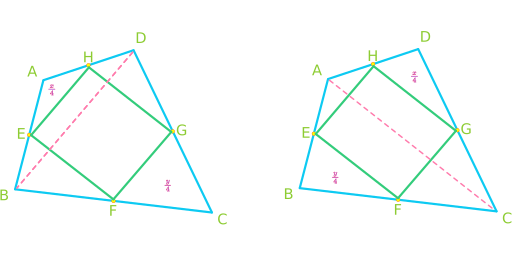
    E=AB midpointH=AD midpointEH= MidlineBecause EF is a midline and triangle AEH shares vertex A with ABD,its base and height are each half of those of ABD.S=12ahSABD=12×(1a)×(1h)SAEH=12×(12a)×(12h)Properties of Similar trianglesAEHABD=18ah12ah=1812=14


    {SABD=xSBCD=y{SDAC=xSABC=ySAEH=14SABDSCFG=14SBCDSDHG=14SACDSBEF=14SABC(SAEH+SCFG)+(SDHG+SBEF)=14(ABD+BCD)+14(ACD+ABC)SABD+SBCD=SABCDSACD+SABC=SABCD14SABCD+14SABCD=24SABCD=12SABCD


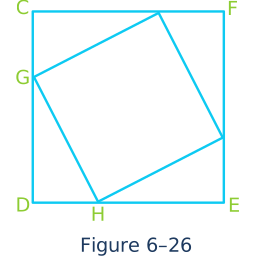
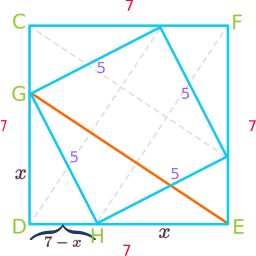
Jump to heading 29Figure 6–26, a square with a perimeter of 20 is inscribed in a square with a perimeter of 28. The maximum distance between a vertex of the small square and a vertex of the large square is ?.

(A)3(B)4(C)5(D)58(E)65

Jump to heading Solution

  • Show known conditions

    DG=xHE=xDH=7xx2+(7x)2=52(3,4,5)x=4GE=42+72=65

Jump to heading Conclusion

  • Derived Solution

    (E)
    According to the Solution, get GE=65, so choose E.

  • Formula used

    c2=a2+b2c=a2+b2Pythagorean theorem(3,4,5)Commonly used pythagorean numbers


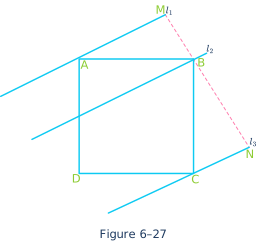
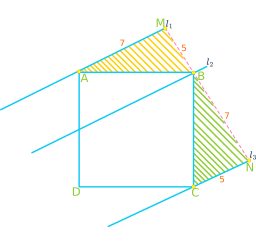
Jump to heading 30Figure 6–27, quadrilateral ABCD is square, l1,l2,l3 pass through points A,B and C respectively, and l1l2l3, BMl1 is at M, BNl3 is at N, if the distance between l1 and l2 is 5, and the distance between l2 and l3 is 7, then the area of square ABCD is ?.

(A)70(B)74(C)140(D)144(E)148

Jump to heading Solution

  • Show known conditions

    SABMSBCNAM=BN=7MB=NC=5AB2=72+52=74SABCD=AB2=74

Jump to heading Conclusion

  • Derived Solution

    (B)
    According to the Solution, get SABCD=74, so choose B.

  • Formula used

    c2=a2+b2c=a2+b2Pythagorean theorem{Find a side and an angle (Acute angle)Find their two sidesRight triangle congruenceS=a2Square area formula


Jump to heading 8.Focus 2

Rectangle

  • The rectangle has two pairs of opposite sides that are perpendicular to each other, and its diagonals bisect each other.
  • The problem of a straight line appearing in a rectangle and dividing it into several triangles.

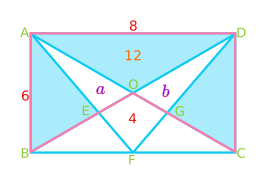
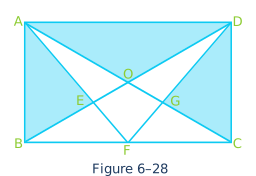
Jump to heading 31Figure 6–28, the two sides of rectangle ABCD are 8 and 6 respectively, and the area of quadrilateral OEFG is 4, then the area of the shaded part is ?.
(A)32(B)28(C)24(D)20(E)16

Jump to heading Solution

  • Show known conditions

    SABCD=6×8=48SAOD=14SABCD=484=12Sa+Sb=SADFSAODSOEFGSADF=12SABCD=482=24SAOD=12SOEFG=4Sa+Sb=24124=8SShaded=34×488=14448=28

Jump to heading Conclusion

  • Derived Solution

    (B)
    According to the Solution, get SShaded=28, so choose B.

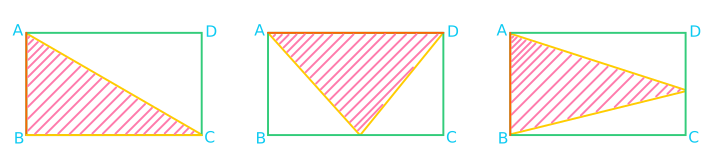
  • Diagonals of a rectangle divide it into four congruent right triangles, each with 14 of the rectangle's area


    S1=S2=S3=S4

  • Jump to heading A triangle with base and height equal to those of a rectangle has 12 the area of the rectangle


    S=12SABCD


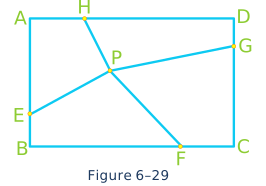
Jump to heading 32Figure 6–29, in rectangle ABCD, points E,F,G,H are on AB,BC,CD,DA respectively, and point P is inside rectangle ABCD. If AB=4,BC=6, AE=CG=3,BF=DH=4, and the area of quadrilateral AEPH is 5, then the area of quadrilateral PFCG is ?.

(A)5(B)6(C)8(D)9(E)10

Jump to heading Solution

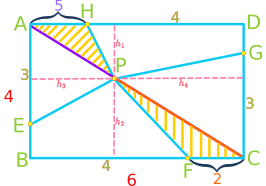
  • Solve by joining heights

    SAPH+SPCF=(12×2×h1)+(12×2×h2)=h1+h2=AB=4=22(h1+h2)=4SAEP+SPCG=(12×3×h3)+(12×3×h4)=h3+h4=BC=6=32(h3+h4)=182=9SAEPH+SPFCG=4+9=13SAEPH=5SPFCG=135=8

Jump to heading Conclusion

  • Derived Solution

    (C)
    According to the Solution, get C, so choose SPFCG=8.

  • Formula used

    S=12ahTriangle area formula


Jump to heading 33A farmer wants to build a rectangular sheep pen with a perimeter of 120 and a diagonal no longer than 50, What is the minimum possible area of the pen ?.

(A)450(B)500(C)520(D)540(E)550

Jump to heading Solution

  • Show known conditions

    C=120a+b=60c=a2+b2502ab=(a+b)2(a2+b2)S=ab=(a+b)2(a2+b2)26025022=550Since both sides are ×(a2+b2), Flip the sign

Jump to heading Conclusion

  • Derived Solution

    (E)
    According to the Solution, get S550, so choose E.

  • Formula used

    c2=a2+b2c=a2+b2Pythagorean theoremS=abRectangle area formula2ab=(a+b)2(a2+b2)Rectangle area identityy2=xx2Definition of square root

  • Additionally, Cuboid surface area identity

    2ab+2bc+2ac=(a+b+c)2(a2+b2+c2)

  • Inequality sign flips

    OperationInequality sign changes?
    Multiply divide by negative✅ Flip the sign
    Multiply divide by positive❌ Do not flip the sign
    Add subtract both sides❌ Do not flip the sign

Jump to heading 9.Focus 3

Rhombus

  • In a rhombus, the two diagonals bisect each other at right angles, and its area equals half the product of the diagonals.

Jump to heading 34Given a rhombus whose two diagonals have lengths 10 and 24 respectively, the area of the rhombus is ?.

(A)110(B)120(C)130(D)140(E)160

Jump to heading Solution

S=10×242=120

Jump to heading Conclusion

  • Derived Solution

    (B)
    According to the Solution, get S=120, so choose B.

  • Formula used

    S=l1l22Rhombus area formula


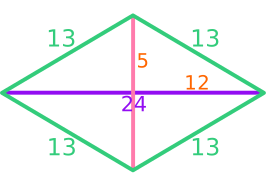
Jump to heading 35Given a rhombus with a perimeter of 52 and one diagonal of length 24, the area of the rhombus is ?.

(A)110(B)120(C)130(D)140(E)160

Jump to heading Solution

  • Show known conditions

    Side length=524=13l1=24l2=(5,12,13)5×2=10S=10×242=120

Jump to heading Conclusion

  • Derived Solution

    (B)
    According to the Solution, get S=120, so choose B.

  • Formula used

    (5,12,13)Commonly used pythagorean numbersS=l1l22Rhombus area formula


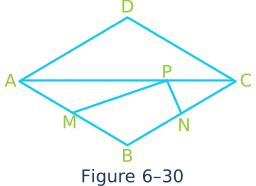
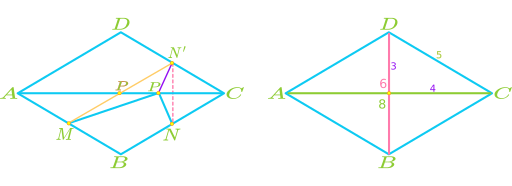
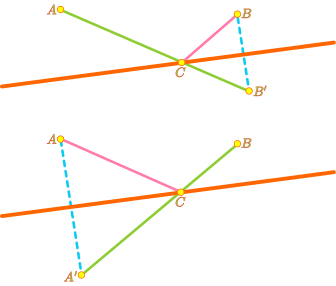
Jump to heading 36Figure 6–30, in rhombus ABCD, the lengths of the two diagonals are 6 and 8 respectively, point P is a moving point on AC, M,N are the midpoints of AB,AC respectively, then the minimum value of PM+PN is ?.

(A)3(B)4(C)5(D)6(E)7

Jump to heading Solution

  • Solve by Reflectional symmetry

    The symmetric point of N about AC is N.PM+PN=PM+PNMNa+b>cMN=ADLet M,N be the midpoints of AB,DC, respectively.(3,4,5)DC=5AD=DC=5PM+PN5

Jump to heading Conclusion

  • Derived Solution

    (C)
    According to the Solution, get PM+PN=PM+PN5, so choose C.

  • Formula used

    (3,4,5)Commonly used pythagorean numbersa+b>cTrilateral relations

  • Reflectional symmetry


    After reaching the orange line by the shortest distance, return B. ACB


Jump to heading 10.Focus 4

Parallelogram

  • The two pairs of opposite sides of a parallelogram are parallel and equal. The core point of a parallelogram is the diagonal. In addition, if there are no other requirements, the parallelogram can be specialized into a rectangle or square to find the answer.

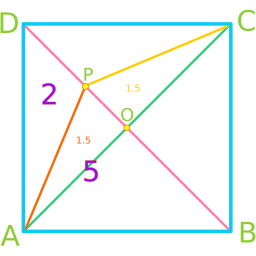
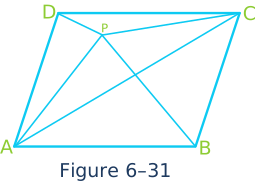
Jump to heading 37Figure 6–31, it is known that P is a point inside the parallelogram ABCD, and SPAB=5,SPAD=2, then SPAC=?.
(A)2(B)3(C)3.5(D)4(E)5

Jump to heading Solution

  • Solve by specializing to a square

    SABD=2+5=7SAOB=72=3.5SAOP=53.5=1.5SPOC=SAOP=1.5SPAC=SAOP+SPOC=1.5+1.5=3

Jump to heading Conclusion

  • Derived Solution

    (B)
    According to the Solution, get SPAC=3, so choose B.


Jump to heading 11.Focus 5

Trapezoid

  • Analyze, according to the area formula and properties of trapezoid, paying attention to the two special types of trapezoids: right trapezoids and isosceles trapezoids.

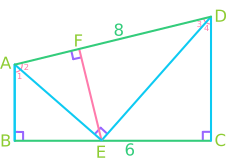
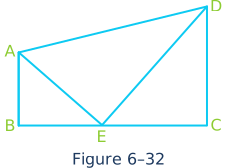
Jump to heading 38Figure 6–32, ABBC at point B, CDBC at point C, the angle bisectors of BAD and CDA intersect at point E on BC, AD=8,BC=6, then the area of quadrilateral ABCD is ?.
(A)12(B)24(C)36(D)48(E)96

Jump to heading Solution

  • Show known conditions

    ABCD=Right trapezoidABCDBAD+CDA=180adjacent interior angles 180SABCD=AB+CD2×BCThe points on the angle bisector dividethe left and right triangles into two congruent triangles.EFAABEDFEDECAF=ABDF=CDAF+DF=AB+CD=AD=882×6=24

Jump to heading Conclusion

  • Derived Solution

    (B)
    According to the Solution, get SABCD=24, so choose B.

  • Formula used

    {1=42=41+4=180Angle relationshipS=a+b2hTrapezoid area formula


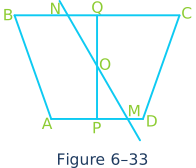
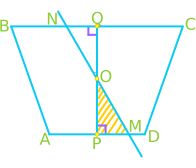
Jump to heading 39Figure 6–33, in trapezoid ABCD, ADBC. Points P,Q are the midpoints of AD,BC respectively. Point O is the midpoint of PQ. A line is drawn through point O, intersecting AD at point M and BC at point N. Then the area ratio of quadrilaterals AMNB and MDCN is ?.

(A)12(B)1(C)23(D)32(E)2

Jump to heading Solution

  • Show known conditions

    SAMNB=SABCD2+SPOMSNOQ{NQO=MPORight angles are equalPOM=NOQVertical angles are equalNOQPOMSAMNB=SABCD2SMDCN=SABCD2SAMNBSMDCN=11=1

Jump to heading Conclusion

  • Derived Solution

    (B)
    According to the Solution, get fracSAMNBSMDCN=1, so choose B.


Jump to heading 12.Focus 6

Other quadrilaterals

  • When encountering other quadrilaterals, you can divide them into triangles to solve the problem or analyze them using the properties of special quadrilaterals.

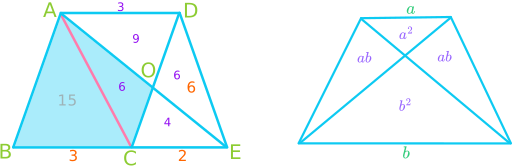
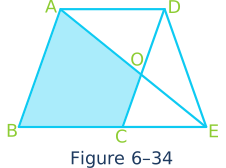
Jump to heading 40Figure 6–34, given that ABCD is a parallelogram, and BC:CE=3:2, and the area of triangle ODE is 6. Then the area of the shaded region is ?.
(A)20(B)21(C)22(D)24(E)26

Jump to heading Solution

  • Solve by forming a trapezoid through the diagonals of irregular quadrilateral

    Join the diagonal ACACED=TrapezoidAD=BCParallelogramAD:CE=3:2{a2=32=9b2=22=4ab=2×3=6SODEab=66=1{a2=1×9=9b2=1×4=4ab=1×6=6SACD=6+9=15SABC=SACD=15SShaded=15+6=21

Jump to heading Conclusion

  • Derived Solution

    (B)
    According to the Solution, get SShaded=15+6=21, so choose B.

  • Formula used

    S1:S3:S2:S4=a2:b2:ab:abButterfly theorem(Trapezoid) & Similarity proportions


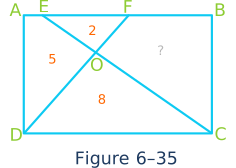
Jump to heading 41Figure 6–35, Rectangle ABCD is divided into four pieces by CE and DF. Given that the areas of three of the pieces are 2,5 and 8 respectively. The area of the remaining quadrilateral OFBC=?.

(A)10(B)9(C)8(D)7(E)6

Jump to heading Solution

  • Solve by forming a trapezoid through the diagonals of irregular quadrilateral

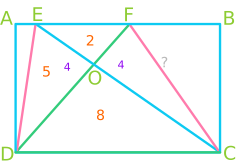
    Join the diagonal CF and DEEDCF=Trapezoid2×8=4×4Top×Bottom=Left×RightSEOD=SCOF=4SCDF=12SABCD=8+4=12SABCD=SCDF×2=24SOFBC=24258=9

Jump to heading Conclusion

  • Derived Solution

    (B)
    According to the Solution, get SOFBC=9, so choose B.

  • Formula used

    S1×S3=S2×S4Top×Bottom=Left×RightS1:S3:S2:S4=a2:b2:ab:abButterfly theorem(Trapezoid) & Similarity proportionsS=12SABCDHalf area rule


Jump to heading 13.Focus 7

Polygon

  • When encountering polygon, you can draw auxiliary lines (Usually by connecting the diagonals) to divide it into several triangles for solving.

  • Jump to heading Regular Hexagon

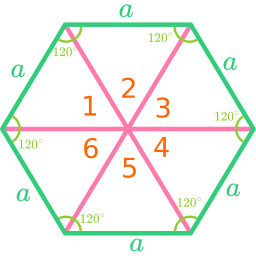
    Divided into 6 equilateral trianglesS=34a2Equilateral triangle area formulaS=34a2×6=332a2

  • Interior Angles of Common Regular Polygons

    Each interior angle=(n2)×180n

    Regular PolygonNumber of Sides(n)Each Interior Angle()
    Equilateral Triangle3(32)×1803=60
    Square4(42)×1804=90
    Regular Pentagon5(52)×1805=108
    Regular Hexagon6(62)×1806=120
    Regular Octagon8(82)×1808=135
    Regular Dodecagon12(122)×18012=150

Jump to heading 42The area of a regular hexagon with a side length of 2 is ?.

(A)23(B)33(C)43(D)63(E)83

Jump to heading Solution

S=332a2=332×22=63

Jump to heading Conclusion

  • Derived Solution

    (D)
    According to the Solution, get S=63, so choose D.

  • Formula used

    S=332a2Regular hexagon area formula


PlatformsCoursesCoursewares
YouTubeWatchCourseware
DailymotionWatch
RumbleWatch